

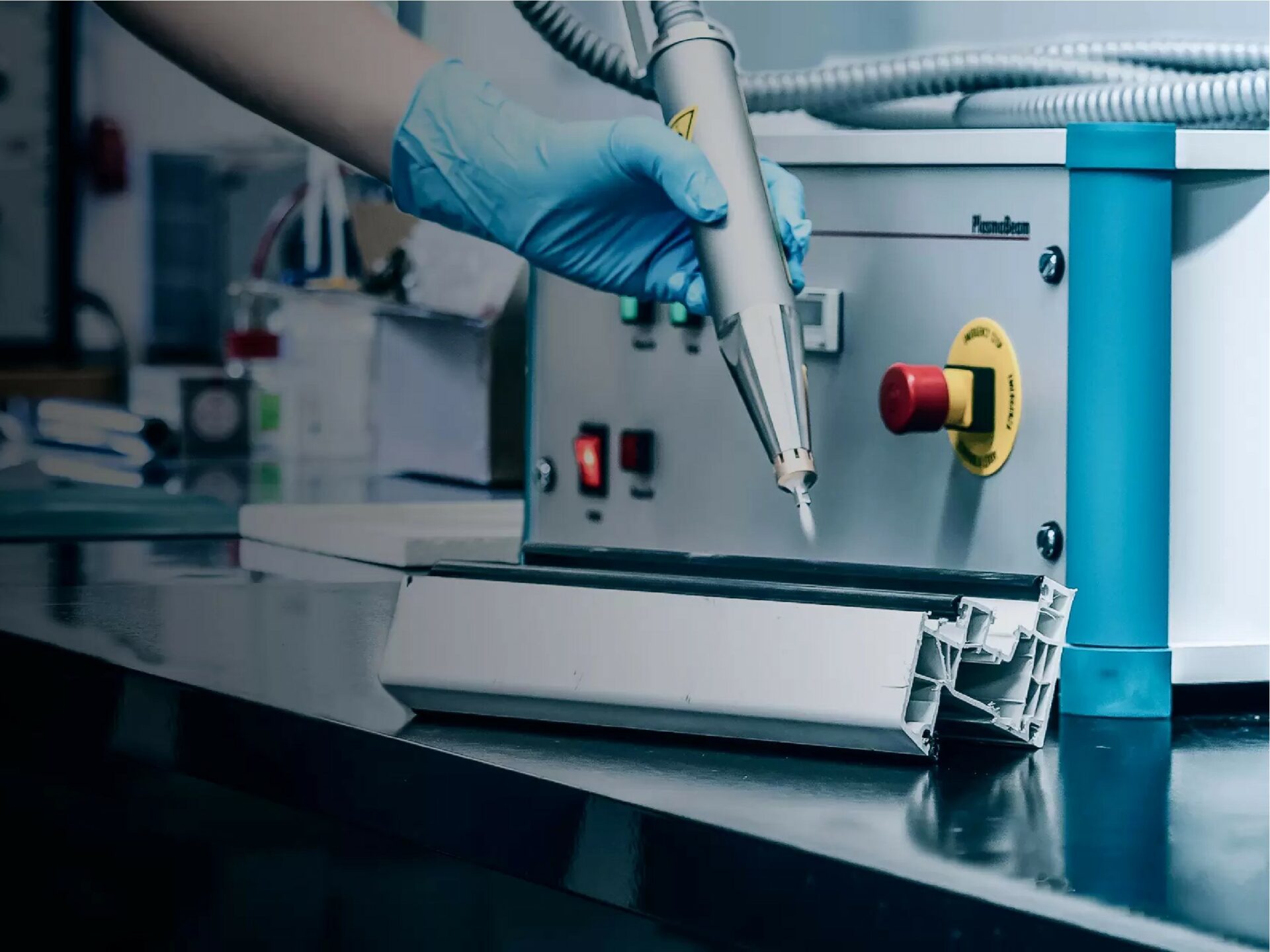
In an industrial bonding process, dispensing accuracy is essential. The amount of material dispensed, bead consistency, positioning and repeatability all contribute to the quality of the final assembly.
However, even before the adhesive is applied, another factor can determine the success of the process: surface condition.
Some materials naturally have low surface energy or may be contaminated with dust, oils, residues or release agents.
Even with the right adhesive and a perfectly calibrated dispensing system, these conditions can result in poor wettability and limited adhesion.
This is precisely where plasma treatment comes into play.
Why prepare a surface before bonding?
To achieve reliable bonding, the adhesive must be able to establish good contact with the substrate and interact effectively with its surface.
However, many materials used in industry can be difficult to bond directly, including certain plastics, polymers, composites and metals, as well as surfaces contaminated during previous manufacturing stages.
This can lead to several issues:
- Poor adhesive wettability;
- Insufficient adhesion;
- Bond failure over time;
- Variations in performance from one part to another;
- Increased reject rates;
- Lack of process repeatability.
Before adjusting the amount of adhesive dispensed or modifying dispensing parameters, it is therefore important to also consider surface preparation.
Plasma treatment: preparing and functionalising the surface without altering the part
Plasma treatment acts on the outermost layers of a surface to modify its physical and/or chemical properties.
Depending on the process and material, plasma can help clean, activate and functionalise the surface, increasing its surface energy and making it more receptive to subsequently applied materials.
The objective is to promote better interaction between the substrate and the material being applied, while preserving the bulk properties of the material.
In an industrial process, plasma treatment can therefore be used prior to various operations, including:
- Bonding;
- Adhesive dispensing;
- Encapsulation;
- Potting;
- Coating;
- Printing;
- Painting or varnishing.
Plasma treatment therefore becomes a key surface preparation and functionalisation step before dispensing.
Plasma Treatment + Dispensing: two stages of the same process
When an assembly requires the application of an adhesive or resin, it can be tempting to focus solely on the dispensing stage.
However, final performance depends on the entire manufacturing process.
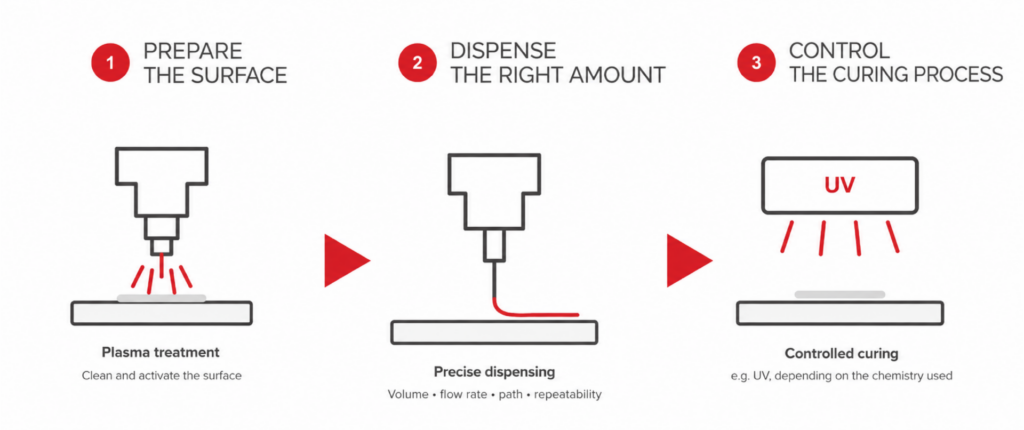
1. Prepare the surface
Plasma treatment modifies the surface properties of the substrate before the material is applied.
2. Dispense the right amount of material
The dispensing system then ensures controlled application of the adhesive, resin or encapsulation material, including volume, flow rate, dispensing path and repeatability.
3. Control the curing process
Depending on the chemistry used, a curing or cross-linking stage may then be required, for example using UV technology.
Successful bonding therefore involves more than simply dispensing the material. Controlling the entire process is essential to ensure reliable and repeatable results.
Atmospheric plasma or low-pressure plasma?
There is no single plasma technology suitable for every application.
The choice depends on several factors, including:
- The material;
- Part geometry;
- The surface area to be treated;
- The required level of treatment;
- Production throughput;
- The level of automation;
- Whether or not the process can be carried out under vacuum.
Atmospheric plasma is particularly suitable for localised treatment and can be easily integrated into automated production lines.
Low-pressure plasma, performed inside a vacuum chamber, can be particularly relevant when several sides of a component or specific geometries need to be treated uniformly.
Testing on actual production parts is therefore essential to determine the most suitable process and parameters.
BT Electronics’ Plasma Expertise
To complement the dispensing solutions offered by Poly Dispensing Systems, its partner BT Electronics provides expertise in plasma processes and surface treatment.
BT Electronics offers both atmospheric and low-pressure plasma equipment designed for industrial applications and demanding technological environments.
This complementary expertise makes it possible to approach bonding applications as a complete process:
- BT Electronics: surface preparation and activation;
- Poly Dispensing Systems: precise dispensing of adhesives, resins and other fluids;
- Poly Dispensing Systems: UV curing process control when required.
Would you like to test your bonding process?
Are you experiencing adhesion, wettability or repeatability issues in a bonding application?
The Poly Dispensing Systems and BT Electronics teams can support you in analysing your process, covering both surface preparation and the dispensing solution.
The objective is to validate the process using your own parts and materials before integrating it into production.
Contact us to discuss your application.