

Beyond design or accessories, price differences between UV curing lamps are mainly explained by the lamp’s technical performance: wavelength, output power, beam uniformity, lifetime, and its ability to efficiently cure different types of materials.
Among these criteria, wavelength is one of the most critical parameters to ensure reliable, fast, and repeatable curing of UV adhesives, UV resins, coatings, or encapsulation materials.
How to choose the right wavelength ?
To select the correct wavelength (λ) for curing a UV or UV-LED material, the key principle is simple: match the emission spectrum of the light source with the effective absorption range of the photoinitiator(s) contained in the material, while also considering thickness, color (i.e. filler or pigment loading), and substrate type.
The photoinitiator: the essential starting point
Each photoinitiator (PI) has a specific absorption curve, usually available in the material’s technical datasheet or from the manufacturer.
The ideal wavelength is the one:
- Where the photoinitiator absorbs light efficiently
- And where the UV lamp delivers sufficient energy (mW/cm² and mJ/cm²)
Always rely on the adhesive supplier’s technical data sheet
It is essential to emphasize that selecting the UV wavelength should never be done arbitrarily. The technical data sheet provided by the adhesive, resin or coating manufacturer is the primary and most reliable source of information, as it specifies the photoinitiators used, their absorption ranges and, in many cases, the recommended curing wavelengths.
This theoretical data provides a critical baseline; however, it must always be validated through application testing to account for real process conditions such as material thickness, geometry, substrates and operating environment.
At PDS, this information can be verified, refined and confirmed through curing trials, ensuring the selected wavelength delivers reliable, repeatable performance in production.
Practical wavelength selection (most common use cases)
Key Takeaways
- 365 nm: very fast, ideal for thin layers and clear materials
- 395 nm: the most versatile wavelength
- 405 nm: best penetration, ideal for encapsulation, thick sections, and challenging substrates
To ensure optimal curing performance, a tailored application study is always recommended.
Contact us to benefit from our specialists’ expertise and make sure you select the UV lamp and wavelength best suited to your application.
Measuring and ensuring proper UV output: the key role of radiometry
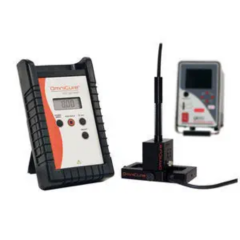
To achieve consistent and reliable UV curing, wavelength selection alone is not sufficient the actual UV output delivered at the curing point must be controlled and measured.
The OmniCure LS200 UV LED Radiometry and Calibration System (Excelitas) enables accurate measurement of irradiance (mW/cm²) and energy dose (mJ/cm²) directly at the application point. This tool is essential for:
- Verifying that the delivered UV output meets the adhesive’s requirements
- Monitoring process stability over time
- Comparing different configurations (wavelength, working distance, optics)
- Detecting performance drift due to LED aging or contamination
To ensure measurement accuracy and traceability, the radiometer can be calibrated periodically, typically on an annual basis, in line with industrial best practices and quality requirements.
Discover the Omnicure LX500 – Our recommended solution
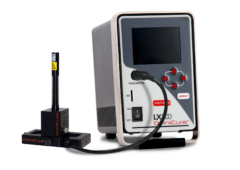
Among the most versatile solutions on the market, the Omnicure LX500 stands out as an industrial benchmark.
This UV LED spot curing system offers:
- Multiple available wavelengths : The LX500 can control up to four independent UV LED heads, allowing simultaneous use of multiple curing wavelengths (365 nm, 385 nm, 395 nm, and 405 nm) depending on application requirements.
- Stable and controlled output power : UV LED heads compatible with the LX500 deliver high irradiance across a wide wavelength range, with high intensity levels to optimize cure times: up to approximately 28 W/cm² at 385 nm or more than 27 W/cm² at 395 nm, while maintaining significantly higher energy efficiency than traditional arc lamps.
- Excellent process repeatability : Equipped with Intelli-Lamp® technology, the LX500 continuously monitors LED head temperature and lifetime, ensuring optical stability within ±5% and consistent performance over time. This stability is critical for achieving repeatable results when curing UV adhesives, resins, or coatings.
Choosing the right UV lamp and the correct wavelength is essential to secure your process. Our teams support you with selection, testing, and optimization of your UV curing applications.
Focus your LED on the useful area by concentrating the measured optical power.
Focusing lenses play a critical role in maximizing UV LED curing efficiency. Mounted at the end of the LED head, they concentrate the emitted light onto a defined curing area.
Depending on their diameter ; 3, 6, 8, 10 or 12 mm ; focusing lenses allow users to:
- Match the spot size precisely to the curing area
- Increase local irradiance for highly targeted applications
- Cure small, localized areas, bonding points or complex geometries
- Optimize energy efficiency without oversizing the overall UV power
Lens selection is therefore fully complementary to wavelength and output power selection and should be defined according to the application, working distance and required curing area.